
A 510 battery is a cell in a 510-threaded wrapper. The printed capacity is a claim about the cell; what helps decide whether your product performs is the cell inside it under your device’s load. This page is for buyers sourcing a 510 cell in quantity who need a specification that holds across a run. It is not for someone choosing a single retail unit, comparing disposables, or hunting for the cheapest cell. It gives you three checks — compliance and provenance, interface fit, and discharge under load — and a record method; to run them you need the certificates for the market you ship to, the device’s current limit (from its spec sheet, or derived from the coil’s resistance), and the cell’s date code. It will not name a best battery or tell you how much to order.
Check one: compliance and provenance
Start with the documents, because they are cheap to verify and a fast way to eliminate a supplier. Ask for the UN38.3 test summary, the IEC 62133-2 or UL1642/UL2054 certification the market you ship to needs, and the MSDS. Then verify the certificates, not just collect them: the certificate should still be valid — not expired or revoked — and the holder should match the cell manufacturer. The scope should cover the specific cell model and part number you are buying, not a near model, and the certificate number can be checked with the issuer or an accredited laboratory. Ask for the cell manufacturer and part number, not just the brand on the wrapper — a renamed or relabelled cell is a risk you cannot verify from the label alone. Ask what state of charge the cells ship at, and for the date code; set an age limit counted from the date code, in months, tied to the certificate’s validity period, and a storage condition, because cells outside that window can drift from the capacity they were built to. If the certificates or the provenance are missing, that is a finding, not a negotiation.
Check two: interface fit
The 510 is a device-side connection standard, so the battery side has to match your device. Confirm the thread length, and whether the device expects the 510 or the 510-eGo hybrid — a mismatch is a fit failure rather than a performance failure, and it is cheap to catch. Confirm the centre pin: a fixed pin and a spring-loaded pin behave differently on different devices, and a device that does not seat without force is unlikely to resolve in production. Ask whether the battery carries a protection circuit, because a protected cell is longer and changes the fit; if it does, the certification and part number should cover the protected assembly, not the bare cell.
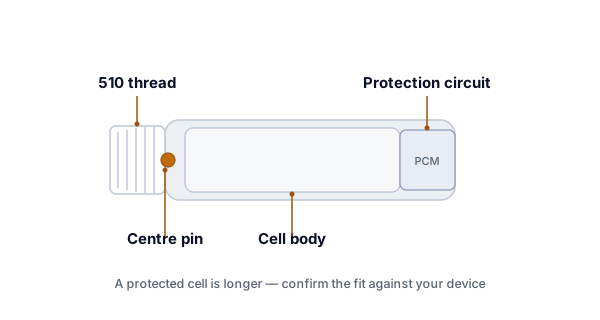
A 510 battery labelled with the connection points the buyer checks — the 510 thread, the centre pin and the protection circuit. A protected cell is longer, so confirm the fit against your device.
Check three: discharge under load
This is a check that can separate a cell that performs from one that only claims to, at the load your device actually draws, and the branch depends on your device. On a regulated device the board limits the current, so the practical question is the measured capacity at the current the board actually draws, and the board’s low-voltage cutoff — the criterion is the capacity measured at that current, against a tolerance you set — not the printed mAh. On an unregulated or mechanical device, the discharge current is a safety boundary: the cell’s continuous discharge rating — stated to a declared cutoff voltage and reference temperature — should exceed the device’s maximum current by the headroom you set and record, so the rating is a margin over what the device draws rather than at its limit. On a mechanical device the current is highest at full charge, because current rises with voltage across the coil — so the worst case is at the cell’s highest voltage (about 4.2 V), not at the lowest. The spec sheet does not give a maximum current for a mechanical device: you derive it from the coil’s stated resistance and the full-charge voltage, using the lowest resistance in the tolerance range to get the highest current, and record the derivation. On a regulated device the input current is highest as the cell approaches its cutoff, so the worst case there is at the lowest voltage. Where the spec sheet gives the figure, use it; where it does not, derive it and record how.
The protocol behind the figure
When a supplier gives you a discharge figure, ask what it was measured at: the C-rate, the cutoff voltage (2.5 V or 2.75 V), the reference temperature (25 °C is the usual baseline), the load current, and the sample size — and whether the figure is the minimum or the mean of that sample. A figure that is a nameplate claim rather than a measured result is not comparable to one that is. A supplier who states the cell’s chemistry, rated capacity and measured discharge in writing is giving you a comparable specification; one who can only quote the printed mAh is giving you a claim.
The buyer's path: from label to order
- A procurement manager for a vape hardware brand needs a 510 cell that holds up across a full production run.
- A sample arrives with a printed capacity that looks adequate, and a device that needs a specific thread length and centre pin.
- The printed mAh is a claim, and the discharge figure the device needs, the certifications and the cell provenance are not stated.
- The buyer either asks back for documents and measured figures, or proceeds on the label and risks a defect at quantity.
- A cell that underperforms under load may produce returns and rework that cost more than the per-unit saving on the cell.
- The buyer can settle this now by running the three checks and recording the specification and the certificates in writing.
Set the acceptance rule before you commit
Write the acceptance rule into the order before you commit, using the protocol above: how many cells the batch is sampled on and the accept and reject numbers for that sample, the capacity tolerance (stated as a percentage of the measured figure at the agreed current), the discharge headroom, and that the batch and date code are recorded against the certificates with an age limit and storage condition. The rule fixes the test conditions too — the C-rate, the cutoff voltage and the reference temperature from the protocol — so a figure measured under different conditions is not comparable to the rule. A defect found on the sample can be cheaper to fix than one found in a production run, and conformance continues at receiving inspection — but only if the rule is written down first. State in the same order who carries the rework, replacement or return cost if the batch fails the rule; if the contract does not name a remedy, agree one before the run.
The selection method
Write down three checks as a record: compliance and provenance, interface fit, and discharge under load against what your device draws, with the batch or lot number and the date code alongside. Confirm the measured figures and the certificates with the supplier in writing, and keep that record with the order. If a cell cannot meet the discharge figure for the specification you set, that is a finding — the kind of thing you want to know at the sample, before the run commits to the quantity.