
A sample is usually cheap relative to a production run, so its value comes from checking the right things in an order that makes a defect cheap to fix. This page is for buyers who have a sample of a vape hardware product and are about to approve a production run. It is not for someone who has not ordered a sample yet, or who is approving a finished product as a retailer. It will not tell you whether to accept a particular sample; running these checks commits you to nothing. It gives you an ordered checklist and a record template, so a finding at quantity has a baseline. To use it you need the written, versioned specification the sample was built to and an approved limit sample; without them the first finding is that nothing can be judged.
The buyer's path: from sample to approval
- A procurement lead receives a sample of a vape hardware product and needs to approve a production run.
- The sample works and looks acceptable at a glance, so the decision seems easy.
- Fit, function, packaging and cosmetics have not been checked against a standard, and no baseline has been recorded.
- A defect surfaces at quantity and the supplier has no record to compare against, or the buyer accepts a defect they could have caught.
- Rework and returns may cost more than the sample and the time it would have taken to check it.
- The buyer can settle this now by running the checks in order and recording each result against the approved sample.
Check fit and function first
Fit first, on a sample size you state before you start — a count you set, or a rule tied to the defect class you are looking for, with a worked default such as five units where a critical dimension or a thread fit is in question. Does it thread, seat and connect without force or modification, within the tolerance the specification allows? A fit problem usually indicates an upstream cause — a tooling, thread or dimension issue — and that is the class of defect that is expensive to find late. Function second. Does it charge to the specified voltage, and does it discharge at the current your device draws for the duration the specification allows? Function is where a performance defect hides. The tolerance, the voltage, the current and the duration all come from a specification you should have in writing and versioned before you check; if there is no spec, that is the first finding, because nothing can be judged against nothing.
Then packaging and cosmetics, against an agreed grade
Packaging third. Is the artwork correct, does the barcode scan to the grade your market needs, does the packaging survive a drop from the height you specify? Artwork-driven packaging failures are batch-wide and usually trace to the artwork, which is fixable before the run — that is why they come before cosmetics. Cosmetics last — seams, scratches, mould marks, print quality — and they are the part that needs a pre-approved limit sample to settle, because cosmetic acceptance is judgement-based and resists objective measurement. Specify what "acceptable" means for seams, scratches and finish against a limit sample you have approved, because a cosmetic grade is meaningless in the abstract and decisive in practice.
Record a pass, fail or deviation
For each check, decide pass, fail or deviate before you move on. Pass means the unit meets the criterion. Fail means the sample does not meet it: ask for a reworked sample, or raise it with the supplier. Deviate means you accept it with a documented deviation — a deviation is only defensible if it is written down and priced, because a documented, price-adjusted acceptance is a decision, and an undocumented one leaves no basis to hold the supplier to it later. Record the deviation rationale, who acknowledged it in writing, and who carries the cost of a deviated defect found at quantity; if you cannot get that acknowledged, treat it as a fail rather than a deviate.
What the record must contain
Write one row per check, with these columns: the check, the criterion it was judged against and the specification or artwork version, the result, the measured value where there is one, the sample number and the retained-sample reference, the quantity inspected, the inspector and the date. Where you deviate, add the deviation rationale, who acknowledged it in writing, and who carries the cost at quantity. Keep one approved unit as the retained sample, and note what invalidates the approval — a spec or artwork revision, a tooling change, a supplier site change, or a stated re-approval point. The record is what lets you tell a supplier "the sample you approved was different from what you shipped" rather than "something is wrong", and it is the part that survives the order.
The checklist you can run today
Run the checks in order — fit, function, packaging, cosmetics — on the sample size you stated, and record each result against its criterion before you approve anything:
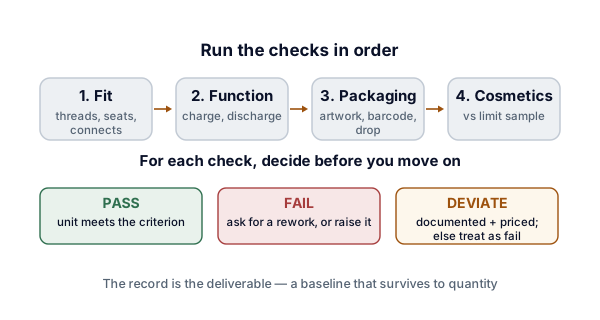
The order of a hardware sample check — fit, function, packaging, cosmetics — and the pass, fail or deviate decision to record for each before you move on.
- Fit: threads, seats and connects without force or modification, within the tolerance in the spec.
- Function: charges to the specified voltage, discharges at the current your device draws for the specified duration.
- Packaging: artwork correct; barcode scans to the symbol grade your market needs; survives a drop from the height and orientation you specify, for the number of cycles you want reported.
- Cosmetics: seams, scratches, mould marks and print quality within the grade set against the approved limit sample.
Decide pass, fail or deviate for each before you move on. The record is the deliverable; the effort it takes is proportional to the number of checks, and small against the rework a missed defect can cause. The exception to "usually cheap" is a tooled sample, or a low-volume run where the sample is a material share of the order value — if that is your case, weigh the sample cost as a decision input rather than a rounding error. If the run is accessories rather than hardware, the checks differ — see what to check on vape accessories before shipment.